In much of the world, farming has quietly faded into the background — a shrinking slice of how people earn a living. But in dozens of countries, it remains the dominant way of life. This ranking measures the share of each country's workforce employed in agriculture, from nations where nearly everyone works the land to city-states where farming has almost vanished entirely.
At a glance · Top 5
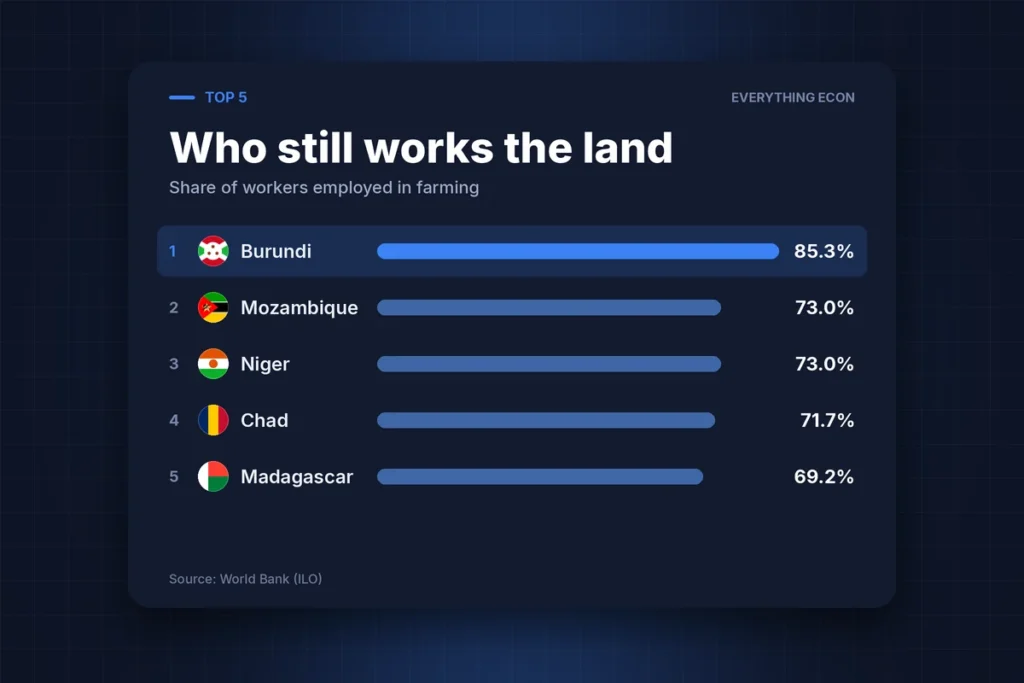
Share of workers employed in farming
- 1Burundi85.3%
- 2Mozambique73.0%
- 3Niger73.0%
- 4Chad71.7%
- 5Madagascar69.2%
Source: World Bank (ILO)
The gap between top and bottom is extraordinary. At one end, a handful of small, wealthy, urbanised economies have agricultural workforces measured in fractions of a percent. At the other, countries where two-thirds or more of working people grow food, raise animals, or fish for a living. Between those extremes lies one of the starkest economic divides on the planet.
A Continent Apart
The top fifteen countries in this ranking read almost like a roll-call of sub-Saharan Africa. Every single one of the world's ten most farm-dependent economies is on the African continent, and 25 countries globally still have at least half their workforce in agriculture — the overwhelming majority of them African. Africa's agricultural employment share stands at 48% as of 2022, nearly ten times higher than Europe's 5%. No other regional gap comes close.
What keeps so many African workers on the land? In most cases, a combination of limited industrialisation, weak infrastructure, and economies that have not yet generated enough jobs in manufacturing or services to absorb people away from farming. South Sudan illustrates how stubborn this can be even when resources exist: despite holding significant oil wealth, around 63.8% of its workforce remains in agriculture. Hyperinflation, poor roads, and deep poverty mean that for the vast majority of South Sudanese, subsistence farming is not a choice so much as a necessity.
The Countries That Left the Farm Behind
At the other end of the scale sit some of the world's most densely built, trade-focused economies. Singapore employs just 0.1% of its workforce in agriculture — the lowest share of any country measured. With virtually no spare land and an economy built on finance, shipping, and manufacturing, this is hardly surprising. What is surprising is that Singapore is now trying to claw back some food production: its "30 by 30" initiative, launched in 2019, aims to grow 30% of the country's nutritional needs locally by 2030, through high-tech urban farming.
Hong Kong (0.2%) and Macao (0.4%) follow a similar logic — tiny, fully urbanised territories with no meaningful agricultural base. Israel and the Bahamas, both at 0.8%, round out the bottom five.
China and India offer two very different stories from the middle of the pack. China has been one of history's fastest movers, cutting its farm employment from around 50% to 22% since the early 2000s as factories and service industries absorbed workers at remarkable speed. Yet in 2022, that share rose for the first time in over two decades — a sign that COVID-19 disruption and economic slowdown pushed some workers back to the land. India, meanwhile, still has 42% of its workforce in agriculture, roughly 249 million people, making it one of the largest farm-labour forces on Earth in absolute terms.
The Country at the Top
Burundi sits alone at number one, with 85.3% of its workforce in agriculture. That figure has barely moved in thirty years — in 1991, the share was around 89%. For a low-income country where farming underpins virtually all economic activity, this near-total dependence reflects how little structural change has occurred. Almost no other country in the world comes this close to having its entire working population tied to the land.
Data: World Bank (ILO), accessed 2024.
Get a new data story like this every week — join the newsletter.
Browse every visualisation on the visualisations page.
Take one home
Every country drawn to scale, as an instant printable download or a museum-quality matte poster printed to order.