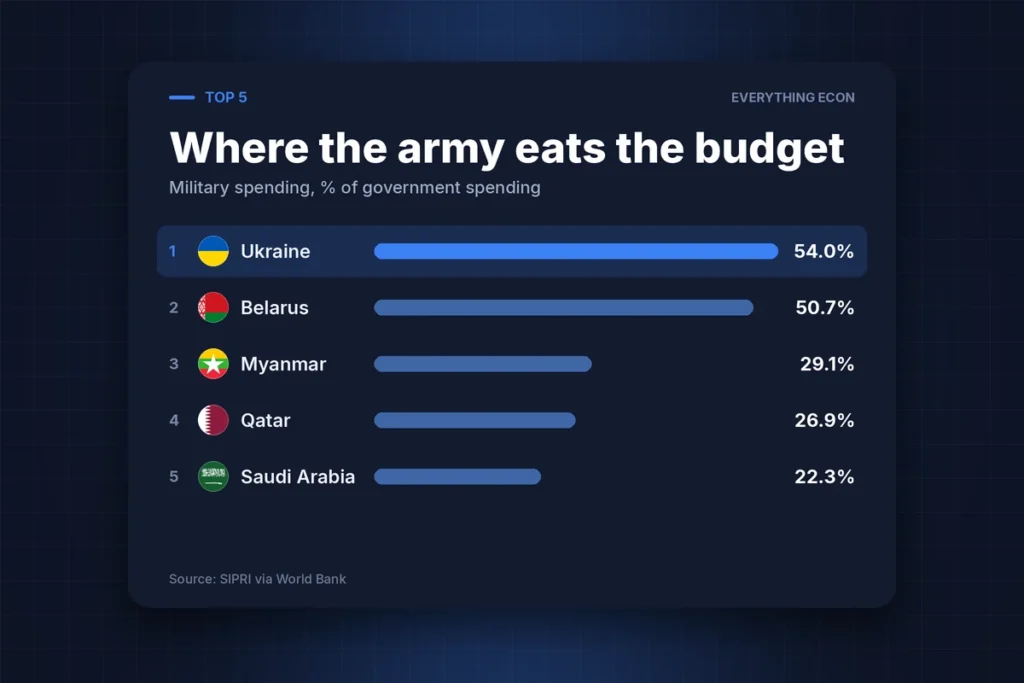
Every government carves up its spending between things like healthcare, education, pensions and defence. This ranking looks at that last slice: the percentage of total government spending that goes to the military, rather than anything else. It's a different question from simply asking how much a country spends in dollar terms, or even how much relative to the size of its economy — this measures priority. When a country pushes a huge share of its budget towards the armed forces, something else, by definition, is being squeezed. And in 2024, the numbers at the top of this list are extreme even by wartime standards.
At a glance · Top 5
Military spending, % of government spending
- 1Ukraine54.0%
- 2Belarus50.7%
- 3Myanmar29.1%
- 4Qatar26.9%
- 5Saudi Arabia22.3%
Source: SIPRI via World Bank
The countries under the most pressure
Belarus sits second on the list, funnelling 50.7% of government spending to defence — an all-time record for the country, and a sharp jump from its historical average of around 34%. That kind of shift usually reflects a decision to align closely with a more powerful neighbour's military posture rather than a response to direct attack.
Myanmar, in third place at 29.1%, tells a starker story. Its military spending jumped 66% in a single year to $5 billion, the largest such increase anywhere in Asia. In February 2024 the ruling military government introduced mass conscription for the first time in the country's post-independence history, and has increasingly relied on weapons from Russia and China to sustain its fight against domestic armed opposition.
Israel, at 20.0%, recorded its steepest annual rise in military spending since the Six-Day War of 1967 — up 65% in a single year to $46.5 billion, driven by the war in Gaza and conflict on multiple fronts.
Oil money, old habits, and Europe's turn
A cluster of Gulf states — Qatar, Saudi Arabia, Oman — sit in the top ten, but for a different reason than war. These are wealthy governments that have long treated defence spending as a form of national insurance and regional influence-buying. Saudi Arabia spent $80.3 billion in 2024, equal to 22.3% of its budget, yet that figure is still 20% below the peak it reached during the 2015 oil boom, when spare cash made big military budgets easy to justify.
Singapore's 20.1% looks similarly striking, but it's actually a historic low for the city-state, well beneath its 1990–2024 average of 26.35% and far under its 2007 peak of 39.2%. Some countries near the top of this ranking, in other words, are winding down, not winding up.
The bigger regional story is Europe, where total military spending hit $693 billion in 2024 — up 83% since 2015. That rise is broad-based, a reaction to the war on the continent's eastern edge reshaping how European governments think about security. Yet not every European country has joined in: Ireland, with no history of large-scale military build-up, ranks last of all 38 European nations at just 1.0% of GDP spent on defence. Malta went further still, holding its budget flat in 2024 — unsurprising for a country that has no standing army at all.
The country spending more than a third on its army
At the very top sits Ukraine, at 54.0% of all government spending. To put that in perspective, it's roughly equivalent to the entire amount the country collects in domestic tax revenue — meaning, in effect, that Ukraine's military effort is being funded almost entirely by outside support layered on top of what the state raises itself. No other country on the list comes close, a reflection of a nation fighting for its survival rather than making a policy choice about priorities.
At the bottom, countries like Sierra Leone (0.0%) and Mauritius (0.5%) show the other extreme: states with no meaningful external military threat, where defence simply isn't where the money goes.
Source: SIPRI via World Bank, 2024 data.
Get a new data story like this every week — join the newsletter.
Browse every visualisation on the visualisations page.
Take one home
Every country drawn to scale, as an instant printable download or a museum-quality matte poster printed to order.