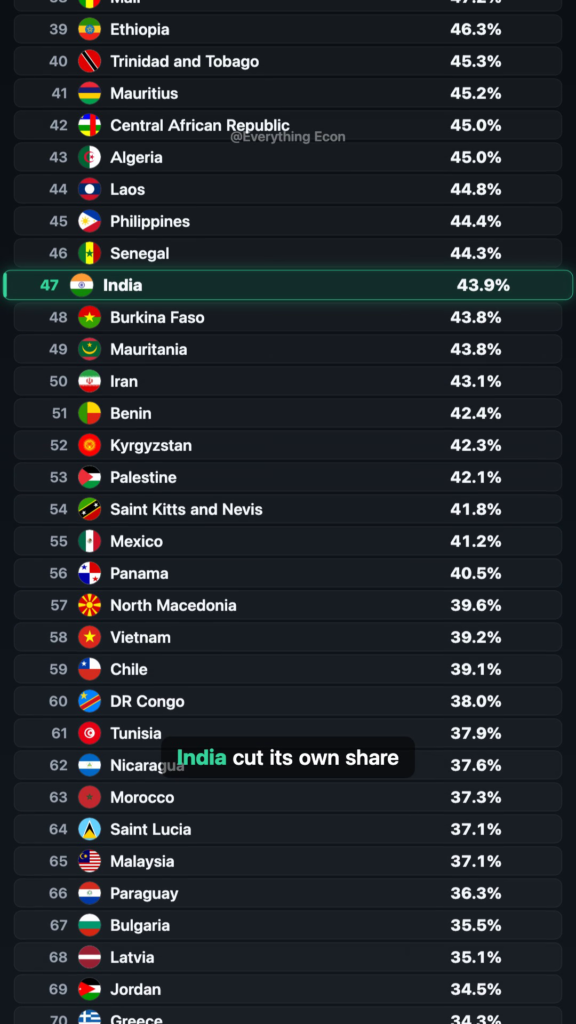
Most people in rich countries barely think about who pays when they see a doctor — insurance or the government quietly picks up the bulk of the bill. But across a wide swathe of the world, that safety net is thin or missing, and the patient pays out of their own pocket for most of their care. This ranking, from the World Bank, measures what share of total health spending in each country comes directly from people's own wallets — not from insurance, employers or government budgets. The numbers range from essentially nothing, where the state covers almost everything, to over 80%, where healthcare is something you save up for or go into debt over.
When War and Weak Systems Collide
Several countries at the top of this list share a grim common thread: conflict has hollowed out the public systems that would otherwise share the cost of care. Afghanistan sits at 77.1% out-of-pocket spending after decades of war destroyed much of its health infrastructure, leaving families to cover nearly four-fifths of their own medical costs. Syria, still gripped by conflict, records 72.4%. Yemen, devastated by years of civil war, comes in at 69.1%. In each case, it isn't that people are choosing to pay privately — it's that there is little functioning alternative. When government health budgets collapse, the bill doesn't disappear; it simply moves to the household.
Big Economies, Big Gaps
Not every country on this list is in crisis. Nigeria, Africa's largest economy, still posts a striking 71.9% out-of-pocket rate, a reminder that the size of a country's economy doesn't automatically translate into strong public health coverage. Bangladesh, a fast-growing economy of over 170 million people, pays 79.3% out-of-pocket — among the highest rates anywhere in Asia. These are not small, isolated nations; they are populous, economically significant countries where health insurance and public provision simply haven't kept pace with the population's needs. A cluster of former Soviet states also stands out: Azerbaijan (64.6%), Uzbekistan (64.1%) and Tajikistan (62.4%) all carry the legacy of health systems that lost their old state funding after the Soviet Union broke up and never fully rebuilt it.
The Country That Pays the Most
At the very top sits Armenia, where 80.5% of all health spending comes directly from patients' pockets — the highest rate in the world. Like its post-Soviet neighbours, Armenia inherited a health system built on state funding that largely dried up after independence, while insurance markets never grew to fill the gap. The result is a country where, for the vast majority of medical needs, there is no safety net standing between a person and their savings.
At the opposite extreme, the gap could hardly be wider. Tuvalu records 0.0% out-of-pocket spending — healthcare there is entirely covered by other sources. Rwanda (4.1%) and Botswana (4.3%) also sit near the bottom, both known for building community health insurance schemes that spread costs across the population rather than leaving them with the individual. Tonga (5.9%) and Oman (6.3%) round out the lowest group, both benefiting from strong state-funded healthcare systems.
Data source: World Bank.
Get a new data story like this every week — join the newsletter.
Browse every visualisation on the visualisations page.