Agriculture's share of GDP measures how much of a country's total economic output comes from growing crops, raising livestock, forestry, and fishing. In wealthy economies this figure is often a rounding error, but in the world's poorest nations it can still define the entire economy. The gap between the two ends of this ranking is one of the starkest in all of economic data: some countries generate under 1% of their output from the land, while others generate nearly half.
The World's Farming-Heaviest Economies
The top of this ranking is dominated by low-income, often conflict-affected nations where industry and services have never fully developed, or have been knocked backwards. Guinea-Bissau (40.6%), Comoros (36.6%), Chad (36.3%) and Mali (33.0%) all sit well above a third of GDP in agriculture, reflecting economies where few alternatives to farming exist. Ethiopia, at #9 with 32.8%, is a telling case: despite posting 9.8% annual growth, 80% of its workforce still farms, showing that fast growth doesn't automatically shrink agriculture's share overnight — it takes decades for workers to shift into factories and offices.
Syria is the outlier that proves the rule works both ways. It ranks #2 at 42.9%, not because its farms are thriving, but because war destroyed everything else faster. Syria's real GDP in 2024 is roughly $13.3 billion — an 80% collapse from pre-war levels. Oil production, industry and services were hit hardest, so agriculture, battered but still standing, now makes up a far larger slice of a much smaller pie. A high ranking here doesn't always mean a strong farm sector; sometimes it means a broken economy around it.
A Regional Divide
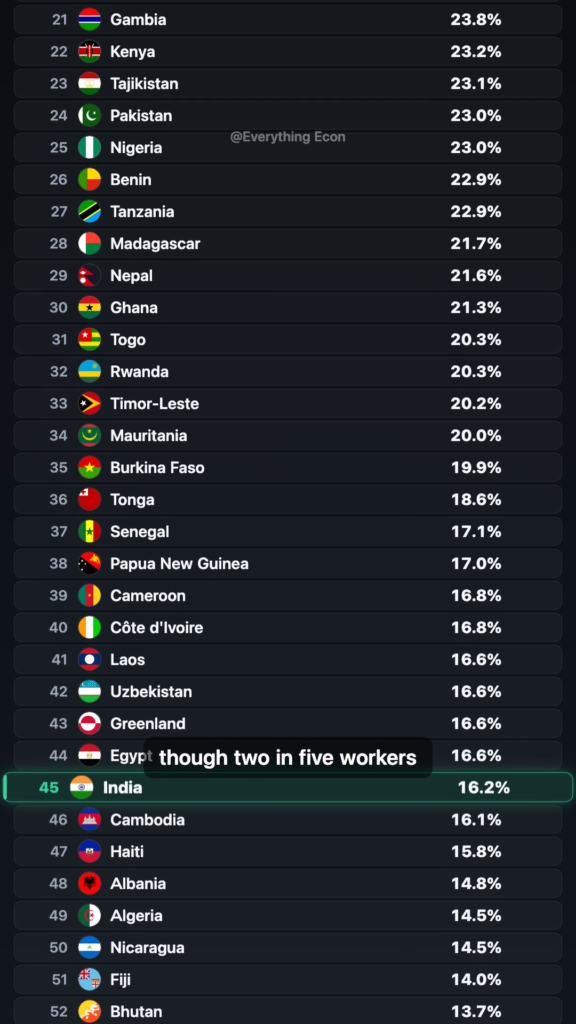
This is overwhelmingly an African story. Africa's average agricultural share of GDP is 18.7%, more than four times Europe's 2.8%, and the top 15 countries in this ranking are almost entirely African nations, among them Burundi, Liberia, Guinea, Malawi, Sierra Leone, Sudan and the Central African Republic, all above 27%. Large emerging economies tell a different story of transition. India's agricultural share has fallen to about 16.2% of GDP in 2025, down sharply from a 1967 peak of 42.75% — yet agriculture still employs 42% of India's workforce, doing much less economic heavy lifting than it used to while still supporting a huge share of the population. China shows the scale version of this: it produced $1.9 trillion in agricultural output in 2024, fully 36% of the world's total, yet because its overall economy is so vast, that output amounts to a modest share of its GDP.
Where Farming Barely Registers
At the opposite end, agriculture is close to invisible. San Marino, Singapore, Hong Kong and Aruba all sit at 0.0%, while Liechtenstein records just 0.2%. These are tiny, densely built, services-or-finance-driven economies with little or no farmland to speak of. Bigger economies tell the same story at scale: the United States, the world's largest economy, draws just 0.96% of GDP from agriculture, and the UK sits even lower at 0.6%. In these places, farming hasn't disappeared, but it has been dwarfed by everything else that got built around it.
The Country at the Top
Topping the entire ranking is Niger, where agriculture accounts for 47.6% of GDP, the highest share on Earth. The scale of this is matched by its workforce: 87% of Niger's population works in farming, making it not just the top of the ranking but close to a one-sector economy. Where most countries in the top 15 have at least some other industry cushioning them, Niger shows just how dominant farming can become when few other paths to income exist.
Source: World Bank, 2024 data.
Get a new data story like this every week — join the newsletter.
Browse every visualisation on the visualisations page.