Count up how many doctors a country has for every 10,000 people, and you get a rough sense of how much medical care its population can draw on. This is a density measure, not a quality score — a high number doesn't guarantee good hospitals, and a low one doesn't mean nobody gets treated. But it does reveal where medical training has been built up over decades, and where it hasn't. The spread here is enormous: Cuba sits at 85.0 doctors per 10,000 people, while Niger has just 0.4. That's more than a 200-fold gap, and the reasons behind it say a lot about history, politics and money.
The top of the table is dominated by small, deliberate systems
Cuba's position at the very top isn't an accident of geography or wealth — it's policy. For decades the country has run an extraordinarily large medical-education system through its ELAM programme, training far more doctors relative to its population than almost anywhere else, and exporting many of them abroad as a form of diplomacy and income. Greece, in second place with 67.1, tells a different story: its surplus of doctors is largely a leftover of the 2010s debt crisis, when the country kept producing physicians even as its economy contracted, leaving it with more doctors than its health system comfortably employs. Portugal (60.2) and Austria (56.7) round out a cluster of European countries where medical training capacity has simply outpaced population growth.
Former Soviet states punch well above their weight
One of the clearest patterns in this ranking is how many former Soviet or Soviet-aligned countries appear near the top. Russia (51.1), Belarus (48.0) and Lithuania (46.5) all inherited the USSR's centralised medical-school system, which was built to produce large numbers of doctors regardless of what the economy needed. Mongolia, at 46.0, is a more surprising entry — a sparsely populated country that nonetheless cracks the global top 15, a legacy of similar centrally planned medical training during its own socialist period. Georgia (56.4) fits the same pattern. Argentina (50.9) is the outlier in this group, leading the ranking in Latin America without any Soviet connection, reflecting its own long-standing tradition of medical education.
Wealth doesn't predict the ranking the way you'd expect
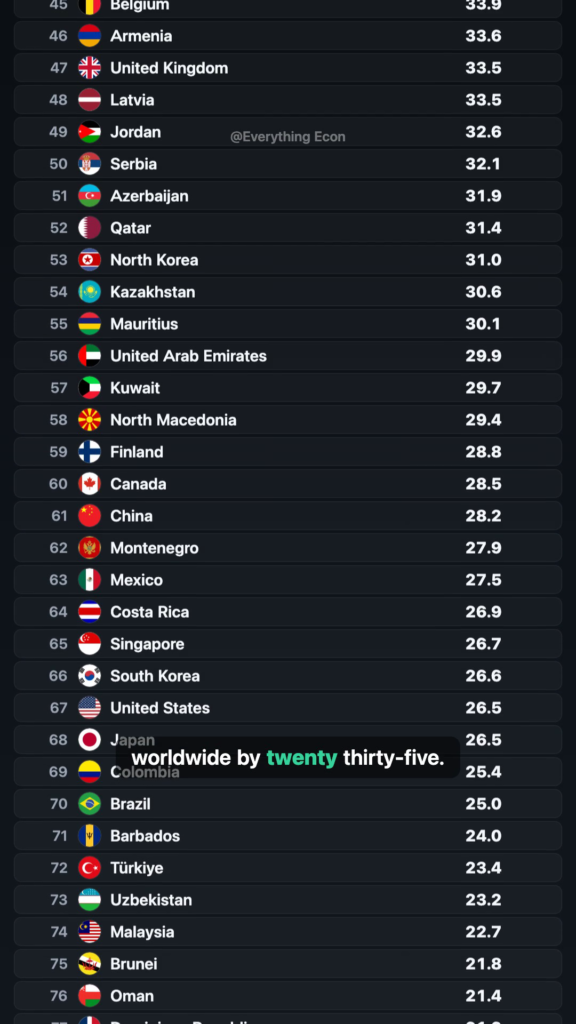
What's striking is how loosely this ranking tracks national income. The United States, one of the richest countries in the world, has only about 36 doctors per 10,000 people — well below Cuba, Greece, or Lithuania. The UK sits lower still, at roughly 31.7. China, despite having one of the fastest-growing economies on earth, has climbed to only about 25 doctors per 10,000, even after more than doubling that figure since the early 2000s. At the bottom of the table, countries including Chad (0.8), Somalia (0.7), Togo (0.6), Papua New Guinea (0.5) and Niger (0.4) show what happens when a country lacks the infrastructure to train doctors at scale and often loses many of the ones it does train to wealthier countries abroad — a pattern sometimes called brain drain.
Cuba's number isn't a fluke — it's the point
So why does Cuba, a country of just 11 million people with a modest economy, top a ranking usually associated with rich nations? The answer is that Cuba has treated medical training as a national strategic asset for over 60 years, building enough capacity to serve its own population several times over and still send thousands of doctors on missions abroad. At 85.0 doctors per 10,000 people, it isn't just ahead of the pack — it's nearly 18 points clear of second-placed Greece, a gap wider than the one separating second place from fifteenth.
Data source: WHO Global Health Observatory.
Get a new data story like this every week — join the newsletter.
Browse every visualisation on the visualisations page.