Adult obesity rate measures the share of a country's adult population classified as obese — not merely overweight, but at a level of excess weight that carries serious health risks like diabetes and heart disease. Looking at this figure across the world reveals one of the starkest divides in global health data: in some nations, obesity affects fewer than one in twenty-five adults, while in others, it affects nearly three in every four. This article uses data from WHO, via Our World in Data.
The Pacific islands dominate the top
Of the ten countries with the highest adult obesity rates on Earth, nine are Pacific Island states. Tonga tops the list at 72.3%, followed by Tokelau at 70.0% and Tuvalu at 64.7% — meaning in these places, obesity is not a minority condition but the typical outcome for an adult. The Bahamas (48.4%) and Saint Kitts and Nevis (47.9%) extend the same pattern into the Caribbean. The main exception to the island trend is Egypt, which at 42.8% is the only large, non-island nation to break into the global top ten.
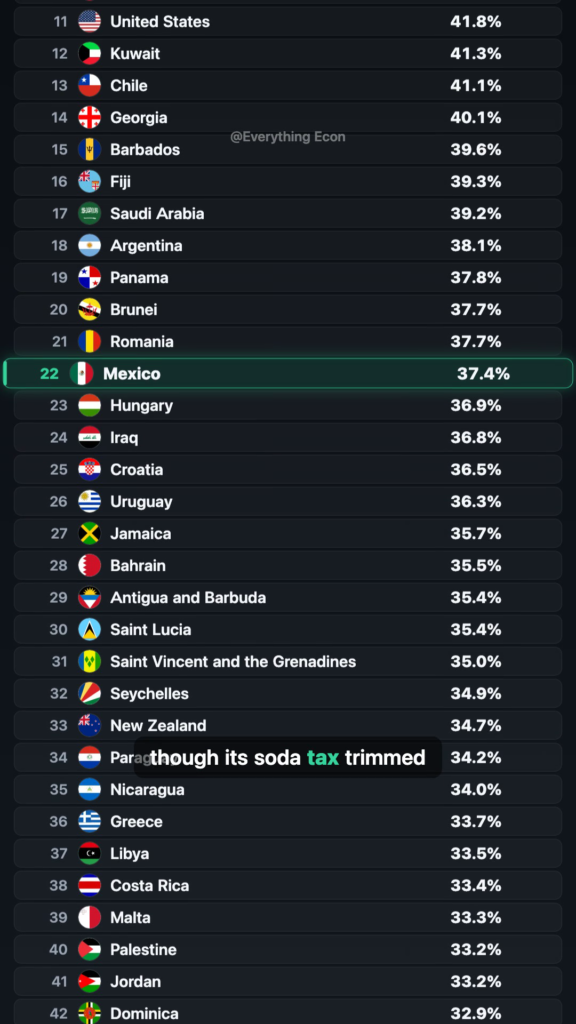
Further down the top fifteen sits a more familiar name: the United States, at 41.8%, ranking 11th in the world. It shares that bracket with Qatar (42.4%), Kuwait (41.3%) and Chile (41.1%) — the latter standing as South America's highest, a notable figure given Chile has one of the region's most aggressive soda taxes. Georgia (40.1%) and Barbados (39.6%) round out the top fifteen.
A tale of two continents
Step back to look at regions rather than individual countries, and the gap becomes even clearer. Australia's regional average obesity rate sits at 45.0% — roughly triple that of Africa, which averages just 14.4% across all 54 of its countries. Africa is, by this measure, the lightest continent on the planet, a reflection of generally lower incomes, different diets, and lifestyles that involve more physical activity by necessity rather than choice.
At the very bottom of the global ranking, Vietnam and Ethiopia are tied for the world's lowest obesity rate at just 2.5%. Just above them sit Timor-Leste (3.3%), Eritrea (3.7%) and Madagascar (4.1%). Japan, though not in the absolute bottom tier, remains one of the world's lowest among wealthy nations at 5.2% — proof that high obesity is not an unavoidable side effect of economic development.
What explains the extremes
The forces pushing the top and bottom apart are a mix of geography, wealth, and food systems. Many Pacific Island nations shifted rapidly in the twentieth century from traditional diets to imported, processed foods, while limited land and car-dependent, spread-out living — seen clearly in Qatar's heat-driven, car-reliant sprawl — curb everyday physical activity. Wealth plays a double role: it can fund abundant, energy-dense food (as in the Gulf states) while poorer nations simply have less food surplus to drive obesity up.
Tonga, the world's number one at 72.3%, illustrates this starkly. Its obesity rate has climbed roughly 35 percentage points since 1980, tracking a rapid shift away from traditional fishing-and-farming diets toward imported, processed staples, compounded by limited opportunities for the kind of physical labour that once shaped daily life. It is a small nation, but its trajectory is a vivid case study in how fast diet and lifestyle can transform a population's health.
Data: WHO, via Our World in Data.
Get a new data story like this every week — join the newsletter.
Browse every visualisation on the visualisations page.