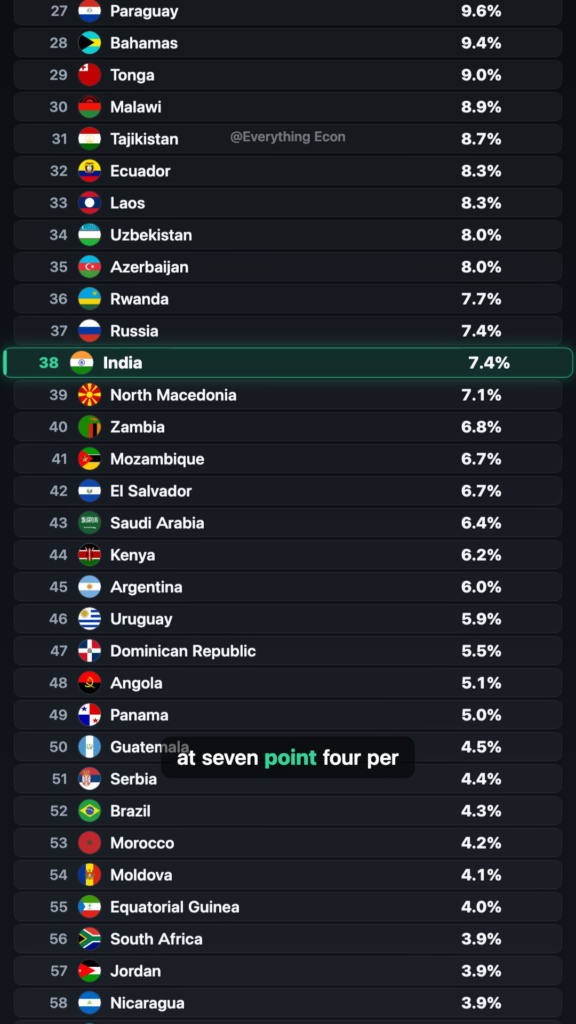
Most rich countries barely notice tariffs anymore — the money comes from income tax, VAT, or, in a few lucky cases, oil. But for a surprising number of poorer and smaller economies, taxes on goods crossing the border remain a core way the state pays its bills. This ranking looks at how much of government revenue comes from tariffs and other trade taxes, using World Bank data across 90 countries. At the top, that share tops 60%. At the bottom, in several European countries, it's exactly zero.
Africa's customs lifeline
Southern and eastern Africa dominate the upper half of this ranking, and the reason is structural, not accidental. Botswana (40.9%), Namibia (33.1%) and Lesotho (19.6%) all belong to the Southern African Customs Union (SACU), a pool that collects tariffs from member countries and redistributes the money by formula. Namibia drew 32.6% of its revenue from that pool in the 2023/24 financial year, and Lesotho leans on it even harder — the pool funds roughly 65% of all Lesotho's government spending, far more than its ranking position alone suggests. For these countries, tariff dependence isn't really about taxing their own imports; it's about a shared revenue-sharing arrangement that happens to be built on customs duties.
Elsewhere on the continent, Ethiopia (25.5%), Togo (20.3%), Tanzania (19.5%) and Madagascar (19.3%) show a more familiar pattern: economies where income tax collection is difficult to enforce, so customs posts — easier to monitor and harder to dodge — become one of the most reliable sources of state revenue.
Rich countries, poor countries, and the exceptions
Asia and the Pacific contribute several entries in the top 15, including the Philippines (24.1%), Vanuatu (21.0%), Nepal (19.1%), Sri Lanka (14.3%) and Mongolia (13.2%) — smaller or developing economies where import duties remain an easier tax to collect than tracking millions of individual incomes.
The bottom of the list tells the opposite story. The United Arab Emirates, Greece, France, Romania and Bosnia and Herzegovina all sit at exactly 0.0%. For the three EU members in that group, the explanation is simple: duties collected at EU borders go straight to the EU's own budget in Brussels, not to the national treasury, so none of it counts as domestic revenue. The UAE's zero comes from a different direction — it funds government spending through other diversified sources rather than relying on any single tax stream. Wealthy outliers like Norway (0.3%) and Israel (0.4%) show the same basic trade-off: once a country has oil wealth or a strong VAT and income tax system, tariffs stop mattering.
One genuine oddity is Andorra, sitting at 19.4% despite being a small, wealthy European microstate inside the EU's customs zone. Unlike its EU neighbours, Andorra still leans on import duties as a meaningful chunk of its own budget — a reminder that geography and EU membership don't automatically erase tariff dependence.
The country that tops them all
That brings us to Somalia, which leads the entire ranking at 62.6% — nearly half again as much as second-placed Botswana. Somalia's government has struggled for decades to build a functioning domestic tax system after years of conflict and weak state institutions, so port customs revenue has become by far its most dependable source of income. It's a stark illustration of what this ranking really measures: not a country's trade volume, but how much its government is forced to rely on the border as its main tax collector.
For context on the scale of these numbers globally, even the United States — hardly known for tariff dependence — saw its effective tariff rate climb to 7.7% in the 2025 fiscal year, the highest since 1947 and a sharp jump from decades spent under 2%.
Source: World Bank.
Get a new data story like this every week — join the newsletter.
Browse every visualisation on the visualisations page.