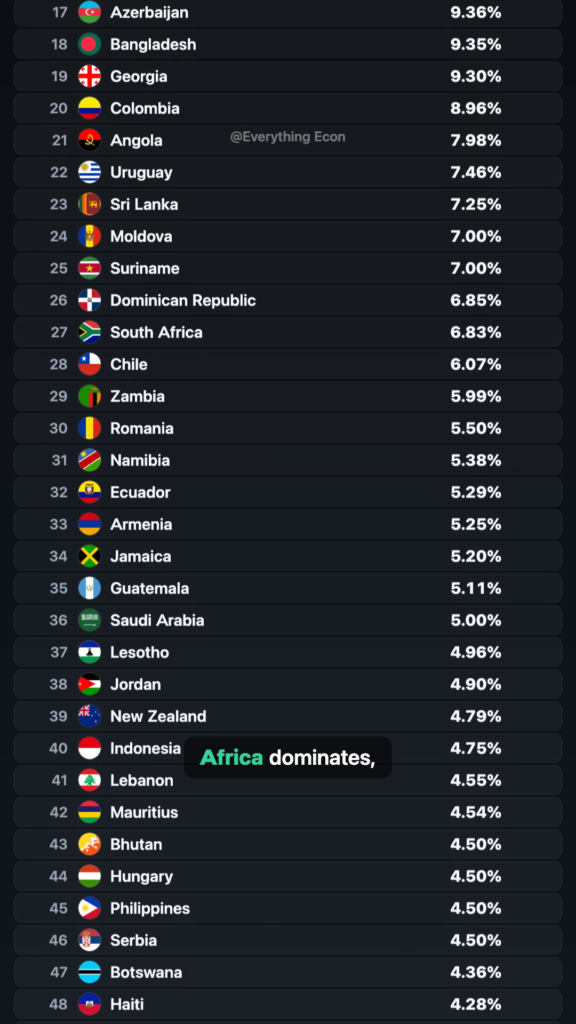
When you put money in a savings account, the bank pays you interest for the privilege of using your cash. That interest rate should, in theory, reward you for waiting rather than spending today. But in much of the world right now, savings rates are set less by reward and more by emergency: central banks use them as a blunt tool to stop inflation from spiralling out of control, or to keep currencies from collapsing. This ranking, built on central bank deposit rates tracked by Trading Economics, shows just how wide that gap has become — from accounts paying 80% a year to accounts paying almost nothing at all.
When a high rate is a warning sign, not a reward
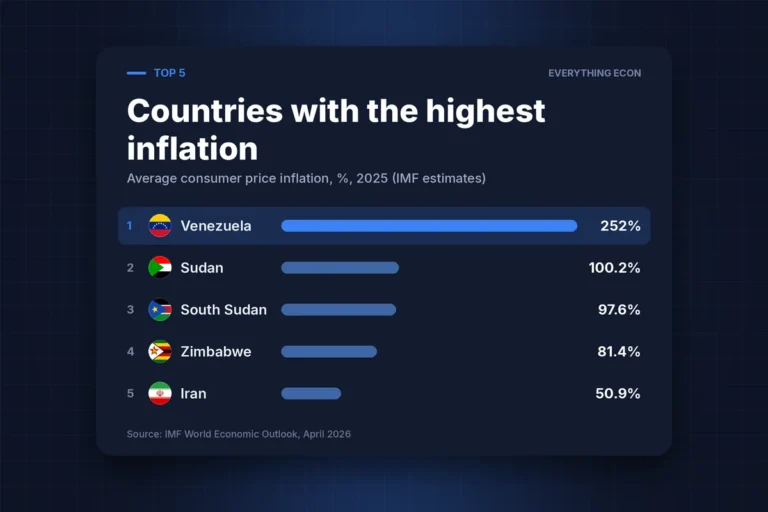
At the top of the list, double-digit and even triple-digit-adjacent rates are not generosity — they are damage control. Venezuela sits far out in front at 80.00%, a figure that reflects an economy where prices have been rising at roughly 270% a year; a savings rate that high is simply trying to stop people's money losing value even faster than it already is. Türkiye follows at 35.50%, the result of its central bank dragging rates up from single digits to fight inflation running near 65%. Argentina's 22.06% tells a similar story, coming after a three-year stretch in which cumulative inflation topped 1,200%. In each case, the "reward" for savers is really an attempt to stop a bad situation from getting worse.
Africa, Eastern Europe and Central Asia: fighting inflation from the middle
Below the extreme cases sits a cluster of countries offering rates between roughly 10% and 15% — Egypt (14.50%), Zimbabwe (13.94%), Uzbekistan (13.90%), Russia (13.08%), Honduras and Madagascar (both 12.44%), Mongolia (12.02%), Kenya (11.98%), Sierra Leone (11.75%), Nigeria (10.34%), Rwanda (10.33%) and Ukraine (10.32%). These aren't crisis economies in the Venezuelan sense, but most share a common thread: persistent inflation that their central banks are actively trying to tame. Egypt, for instance, has cut its rate five times in 2025 as inflation eases, meaning its current figure is already on the way down from recent highs. Kenya and Zimbabwe fit a broader African pattern of central banks keeping rates elevated specifically to keep inflation in check, while Russia and Ukraine reflect the financial strain of war and sanctions.
The bottom of the table: calm economies, barely-there returns
At the opposite extreme, savers in Switzerland, Croatia and Bulgaria earn next to nothing. Switzerland's rate of 0.03% follows the Swiss National Bank cutting its policy rate to 0.00% in June 2025 — a sign of an economy with inflation so low that stimulating borrowing and spending matters more than rewarding savers. Croatia's 0.02%, the lowest figure in the entire ranking, and Bulgaria's 0.25% both trace back to the same cause: adopting or shadowing the euro and its ultra-low interest rate environment, set by the European Central Bank for a currency bloc with historically tame inflation. Barbados (0.17%) and the Maldives (0.25%) sit in similarly calm, low-inflation settings. For savers in these places, money is safe — it just isn't growing.
Put together, this ranking is really a map of inflation fights around the world. The higher the number, the harder a country's central bank is working to stop prices running away; the lower the number, the more settled — or stagnant — its economy already is.
Source: Trading Economics, 2025 data.
Get a new data story like this every week — join the newsletter.
Browse every visualisation on the visualisations page.