
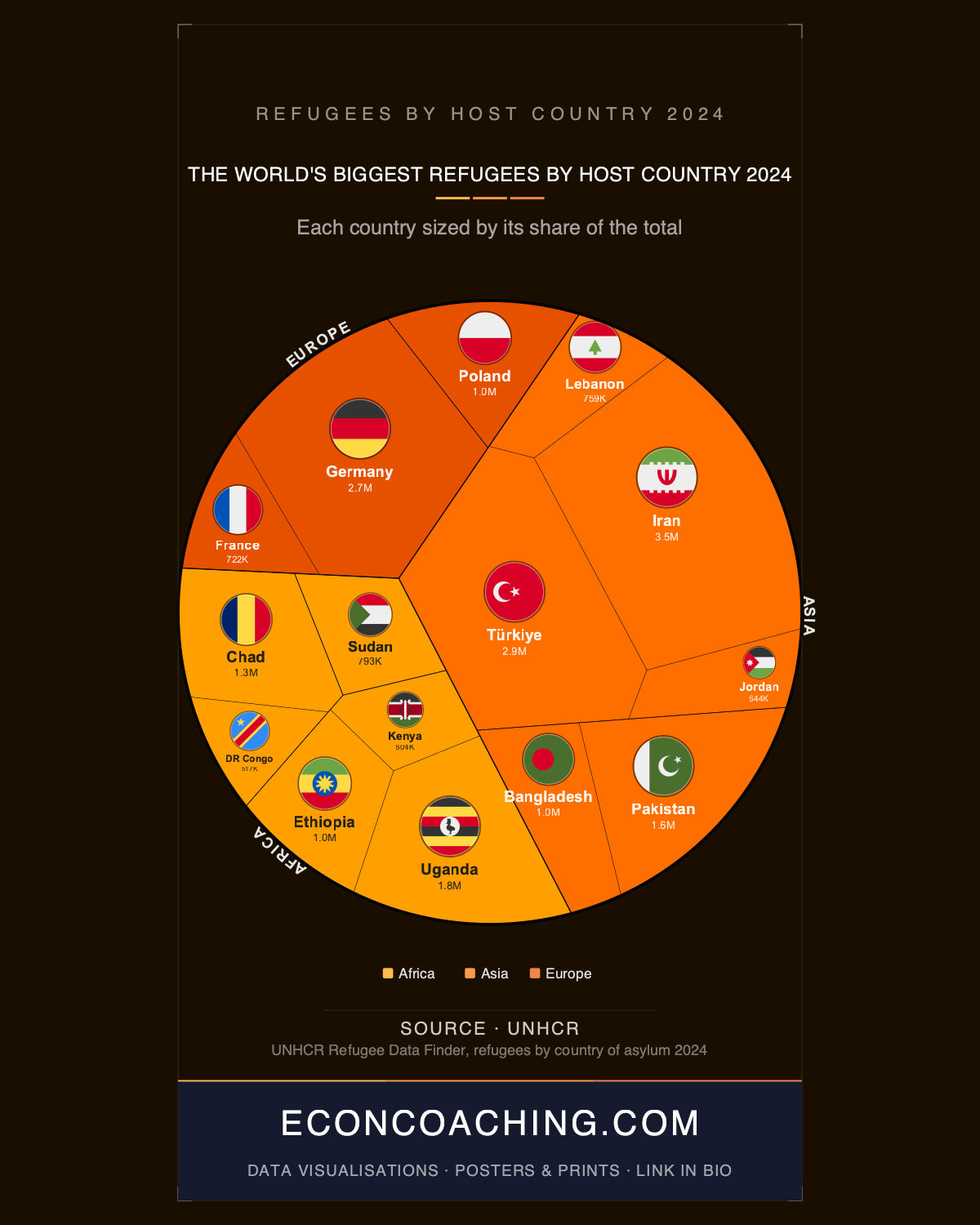
Chad — with a GDP per capita of roughly $917 — hosts 1.28 million refugees. Germany, with a GDP per capita roughly 60 times larger, hosts 2.75 million. Those two numbers sit adjacent in the treemap accompanying this article, where cell area is proportional to refugee population rather than land mass or wealth. The visual distortion is immediate: the countries that dominate the chart are not the ones dominating global economic output, and the gap between hosting capacity and hosting reality runs in the opposite direction from what most public debate assumes.
Iran at the Top — and What That Conceals
Iran displaced Türkiye as the world's top refugee host in 2023, ending Türkiye's ten-year consecutive reign at that position. By end-2024, Iran held 3.49 million registered refugees — nearly entirely Afghans, a population Iran has hosted continuously since the Soviet invasion of Afghanistan in 1979. That is over four decades of unbroken hosting, predating most current Western refugee policy frameworks entirely. Iran and Pakistan together account for almost 90% of the world's 6.1 million Afghan refugees, making geography — not policy generosity — the dominant explanatory variable.
The composition of Iran's hosting is equally striking: 99% of its registered refugees live in urban areas alongside local communities, not in formal camps. But high refugee counts and open policy are not the same thing. Iran deported an estimated 750,000 Afghans in 2024 and announced plans to deport up to 2 million by March 2025, even while holding the world's top host ranking by absolute count. Iran's position on the treemap reflects the scale of the Afghan displacement crisis more than any deliberate humanitarian commitment, and the deportation figures are a necessary corrective to any framing that treats hosting numbers as a proxy for hospitality.
Africa and Asia Are Carrying the Weight
Asia and Africa together account for 78.5% of all refugees across the top ten host nations in this dataset. The three European countries in the top ten — Germany, Poland, and the combined European presence — account for the remaining 21.5%. Uganda, Africa's largest refugee host, held 1.76 million refugees by end-2024, a 10% increase over the prior year driven largely by the Sudan conflict, with women and children comprising 80% of that population. Ethiopia and Chad round out Africa's presence in the top ten, with Chad hosting 1.28 million on a national economy smaller than many mid-sized European cities.
The World Bank's Chad Economic Update 2024 contextualises what that figure means in practice: low-income countries representing just 8% of global population and 0.3% of global GDP host 18% of the world's refugees. The first 19 countries hosting the most refugees relative to their per-capita income are all in Africa and Asia — not one is in Europe or North America. Absolute counts, which favour larger and wealthier economies, are only one lens; on a per-capita basis, Lebanon hosts 130.7 refugees per 1,000 residents, meaning roughly one in every eight people in Lebanon is a refugee, a concentration no European country approaches.
Germany's Surge and What Drives It
Germany's refugee population more than doubled from approximately 1.26 million in 2021 to 2.75 million by end-2024, reaching 4.1% of the country's total population. The primary driver was Russia's full-scale invasion of Ukraine in 2022, which generated European displacement absorbed largely by European neighbors — a dynamic that complicates any simple narrative about wealthy nations hosting refugees from distant conflicts. Germany's position at third in the global ranking is real, but it reflects a European conflict generating European displacement, administered through an EU legal framework with EU funding mechanisms, rather than a unilateral decision to absorb a distant crisis.
Poland's appearance at seventh — with just over one million refugees — reflects the same Ukrainian displacement wave. Both countries' presence in the top ten is structurally different from Uganda's or Chad's: Germany's BAMF processing infrastructure and EU financial transfers provide a qualitatively different resource base than anything available to a country operating on $917 per capita GDP.
Sudan: Host and Origin Simultaneously
Sudan appears at tenth in the host country ranking with 793,000 refugees — and simultaneously represents the world's largest forced displacement situation, with 14.3 million of its own people displaced, including 11.6 million internally and 2.1 million pushed into neighboring countries. The host/origin binary that structures most refugee policy discussion collapses entirely when applied to Sudan. A country actively generating millions of displaced people is simultaneously registering nearly 800,000 refugees within its own borders, largely from earlier waves of South Sudanese and Eritrean displacement that predate the current civil war. UNHCR's Global Trends 2024 report confirmed that by end-2024, 123.2 million people were forcibly displaced globally — a record, and the twelfth consecutive annual increase — with Sudan's dual role representing one of the starkest illustrations of how displacement crises compound rather than resolve.
A Funding System Under Severe Strain
UNHCR faced a record 52% funding gap in 2024, with $10.8 billion budgeted against $5.2 billion available — even as displacement hit its highest level ever recorded. That gap falls disproportionately on operations in the countries least equipped to compensate for it: Uganda, Chad, Ethiopia, and Bangladesh cannot substitute domestic fiscal resources for UNHCR shortfalls in the way European host governments can. The Solutions Strategy for Afghan Refugees and the Global Compact on Refugees both established burden-sharing principles that the funding data suggests are not being operationalised at the required scale.
The forward pressure is structural. Global displacement has risen every year for twelve consecutive years, tripling from approximately 40 million in 2012 to 123.2 million in 2024. The countries absorbing that increase are overwhelmingly those with the least capacity to do so, and the funding architecture designed to compensate for that asymmetry is operating at half its required level. Those two trends, compounding simultaneously, define the policy and fiscal challenge that the 2024 rankings make visible.
For more data-driven analysis of global economics and the trends reshaping the world economy, visit econcoaching.com.
Take this one home
Get this visualisation as a download, wallpaper, or printed poster.
← Back to all visualisations & articles
Follow Everything Econ: YouTube · TikTok · X · Instagram · Facebook