
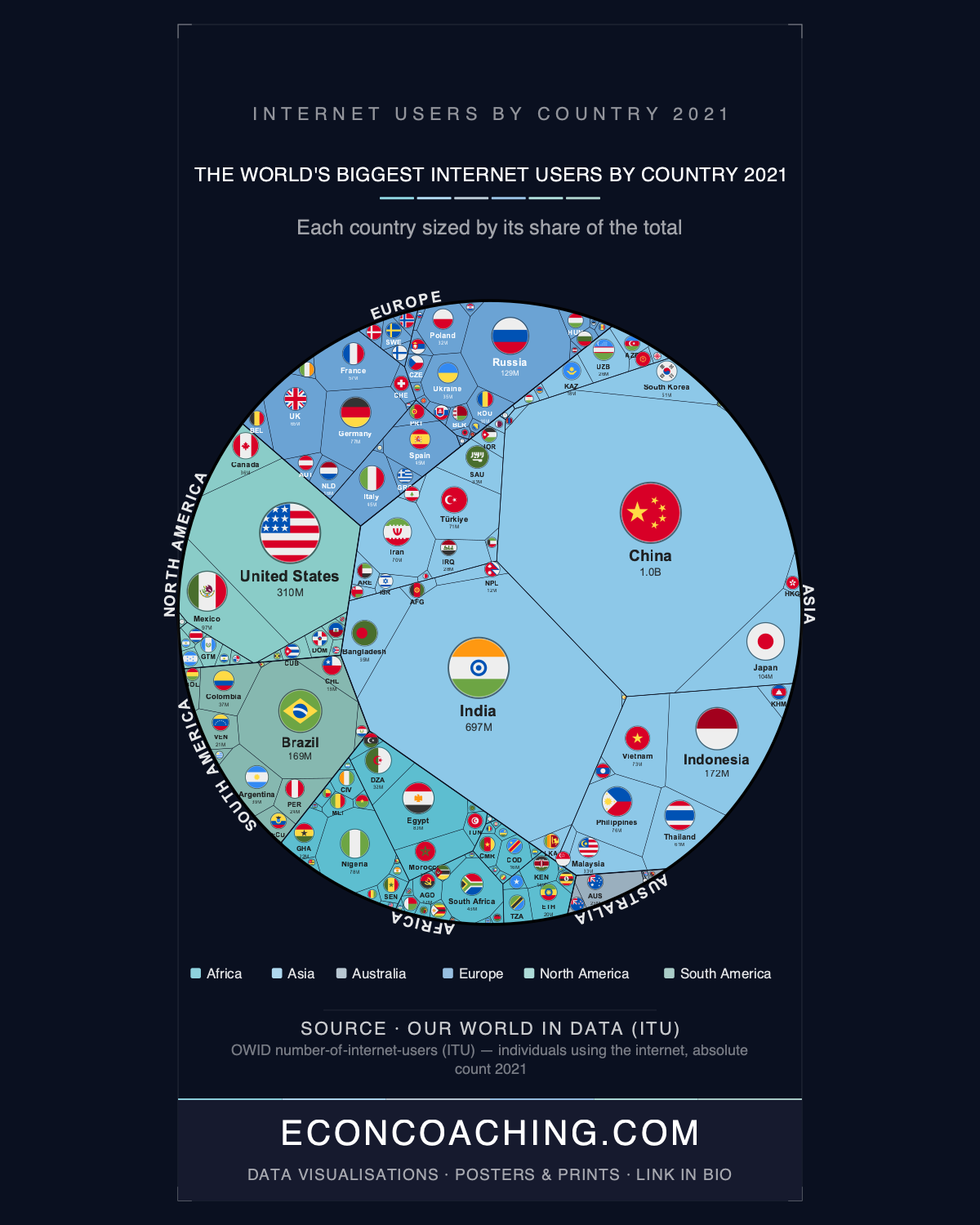
China's rectangle on the treemap holds 1.04 billion internet users. India's, immediately next to it, holds 696.6 million. Together the two countries account for 36.5% of everyone online on Earth in 2021, a larger combined total than Africa, Europe and South America put together. Every other block on the chart, from the United States down to Nigeria, is a rounding error against that pairing.
Two Countries, More Users Than Three Continents
The 2021 dataset (Digital 2021 Global Overview Report, DataReportal, We Are Social and Kepios) puts China at 1.04 billion internet users and India at 696.6 million, against a combined Africa, Europe and South America population of internet users that still falls short of the two Asian giants alone. The scale is a function of population, not of technology leadership. China's own regulator, the China Internet Network Information Center, has tracked this build-out for two decades, and it reflects the same underlying force as India's rise: two countries holding roughly a third of the planet's population were always going to dominate any raw headcount of internet users once mobile broadband reached rural areas. Wealthy, small nations in Scandinavia or the Gulf can sit near 100% penetration and still contribute a fraction of a rectangle to this chart, because the treemap sizes by absolute users, not by connectivity rate.
The Gap That a Decade of Predictions Failed to Close
India overtook the United States to become the world's second-largest internet market around 2016 to 2017, and forecasters at the time treated a run at China as the next logical milestone. It has not happened. By 2025, India's user base had grown to roughly 880 to 900 million people, about 70% penetration, up from just 15% in 2015. Over the same stretch, China still led globally with an estimated 1.1 billion users. India has added hundreds of millions of users in a decade. China has still added more in absolute terms, and the 2021 snapshot of 1.04 billion versus 696.6 million looks, by the 2025 estimates, largely unchanged in its basic shape. Growth in China has plainly slowed as its market approaches saturation, while India, along with South Asia and Sub-Saharan Africa more broadly, is where most of the world's net-new internet users are now being added.
Africa's Small Slice Hides a Fast-Moving Story
Africa held just 10.3% of the world's internet users in the 2021 data despite carrying roughly 17% of the world's population, a gap explained by penetration rates that were still low across much of the continent. That has moved quickly since: African penetration climbed from about 30% in 2020 to roughly 50% by 2025, around 600 million users, a compound annual growth rate near 10%, the fastest of any continent, with projections putting African users above 1.1 billion by 2029. A single continental figure still hides enormous internal variation. East Africa remains the weakest connected subregion, with an estimated 74% of its people still lacking internet access as of the mid-2020s. North Africa tells a different story: Egypt's 79.95 million users actually outrank Nigeria's 77.6 million, even though Nigeria's population is roughly double Egypt's, a direct reflection of North Africa's much higher penetration compared with West Africa.
Nigeria's Apparent Collapse Was a Paperwork Correction
Nigeria's active internet users fell from 163.8 million in December 2023 to 139.2 million in December 2024, according to the Nigerian Communications Commission, a drop the regulator attributed mainly to mass deactivation of SIM cards not linked to National Identity Numbers. Read alone, that number looks like tens of millions of Nigerians losing internet access within a year. Read against its cause, it looks more like an administrative clean-up of subscriber records than a change in how many people actually use the internet or own a device. The distinction matters for anyone using subscriber counts as a proxy for connectivity: Nigeria remains Africa's largest internet market by the ranking (77.6 million users), and the SIM-NIN correction is a reminder that regulatory data can move sharply for reasons that have nothing to do with underlying usage.
Russia and Brazil Anchor Their Continents Alone
Two single countries carry outsized weight within their regions. Russia's 128.6 million internet users make up 19.6% of Europe's entire 654.9 million, putting Russia ahead of Germany, the UK and France as Europe's single largest internet market. Brazil's 169.1 million users account for exactly half of South America's 336.8 million, more than Argentina, Colombia, Peru and Venezuela combined. By contrast, the whole of Oceania, Australia, New Zealand and Pacific nations such as Papua New Guinea and Fiji, totalled just 32.6 million users in 2021, less than a third of Egypt's total on its own. The treemap makes these mismatches between geography and population immediately visible: a small region can dominate the map or all but vanish from it depending on headcount alone.
What the 2021 Baseline Sets Up
By 2025, the ITU's Facts and Figures reporting put global internet penetration at 74%, roughly 6 billion people, up from under 20% in 2005 and up from 5.8 billion in 2024. That leaves 2.2 billion people offline, and the divide is sharply income-linked: 94% of people in high-income countries use the internet against 23% in low-income countries, and 96% of everyone still offline lives in a low- or middle-income nation. The 2021 dataset, drawn from the pandemic period when lockdowns pushed work, school and commerce online, is the baseline against which that 2025 picture is measured. The countries adding the most users from here are not the ones that already dominate the treemap.
For more data-driven analysis of global economics and the trends reshaping the world economy, visit econcoaching.com.
Take this one home
Get this visualisation as a download, wallpaper, or printed poster.
← Back to all visualisations & articles
Follow Everything Econ: YouTube · TikTok · X · Instagram · Facebook