
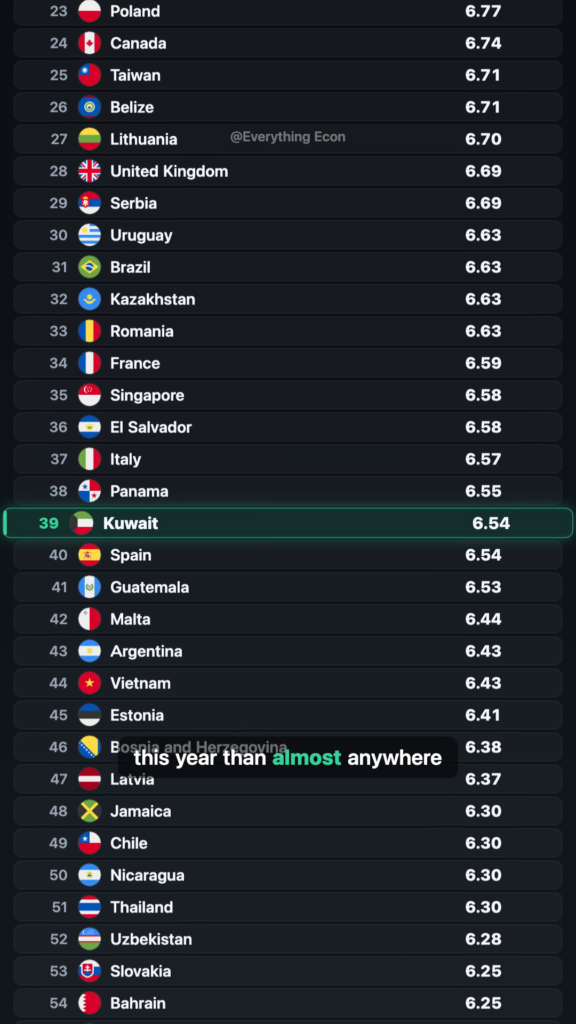
Every year, researchers ask people in nearly every country the same simple question: on a scale of 0 to 10, how satisfied are you with your life? The answers, combined with data on income, health, social support and freedom, produce the World Happiness Report's ranking of 146 countries. It's not a measure of national mood on any given day — it's a broader read on whether people feel their lives are going well, and the 2025 edition shows a world pulling in very different directions.
The countries on the move
The most striking story this year comes from Latin America. Costa Rica leapt from 12th place all the way to 6th, scoring 7.44 — the highest ranking any Latin American country has ever achieved. Mexico's rise has been even longer in the making: it climbed from 25th in 2023 into the global top 10 by 2025, landing at 12th with a score of 6.97. Together, these two results mean Latin America has placed two countries in the world's top 10 happiness rankings for the first time ever, a genuine surprise given the region isn't among the world's wealthiest.
Contrast that with the United States, which fell to 24th place — its lowest-ever position, and a long way down from the 11th-place peak it hit back in 2011. Wealth alone clearly isn't the deciding factor here.
Regional patterns: Europe holds steady, Asia and Africa lag
Northern and Western Europe continue to dominate the upper end of the table. Iceland and Denmark are tied at 7.54, followed by Sweden, Norway, the Netherlands, Israel, Luxembourg and Switzerland all scoring above 7. These countries tend to share strong social safety nets, high levels of trust between citizens, and reliable public institutions — factors the report consistently links to higher life satisfaction.
Asia tells a different story. China sits at a modest 65th, well below where its economic size might suggest, while India ranks 116th, pulling down the region's average despite having pockets of considerable national wealth. It's a reminder that a country's overall economic output doesn't automatically translate into how satisfied its population feels.
Africa anchors the bottom of the table. DR Congo (3.76), Malawi (3.28) and Sierra Leone (3.25) are among the world's lowest scorers, alongside Zimbabwe (3.35) and Botswana (3.46). Sierra Leone also posted one of the steepest year-on-year declines in the 2025 report, alongside Kuwait and Afghanistan.
What's driving the extremes
At the very bottom sits Afghanistan, with a score of around 1.45 — the lowest ever recorded in the report's history. Decades of conflict, economic collapse and severe restrictions on daily life, particularly for women, are reflected starkly in that number.
Lebanon offers a cautionary tale about how quickly things can change: its happiness score has roughly halved since 2017, as a currency collapse wiped out savings and upended ordinary life, pushing it down near the very bottom of the 146 countries ranked.
At the top, the pattern is different. Finland has now been ranked the world's happiest country for eight consecutive years running through 2025, scoring 7.76. What sets Finland apart isn't dramatic wealth compared with its neighbours, but a consistent combination of strong social trust, dependable public services, and a sense that help is available if things go wrong. Iceland and Denmark follow closely behind, reinforcing a pattern that has held for nearly a decade: it's the Nordic and nearby Northern European countries, not the world's largest economies, that consistently report the highest life satisfaction.
Source: World Happiness Report via Our World in Data, 2025 edition.
Get a new data story like this every week — join the newsletter.
Browse every visualisation on the visualisations page.
Keep exploring
 Economy · GraphicWho Holds America’s Debt? The $9.25tn Owned Abroad407K views3 min read
 Economy · RankingThe Countries Where an Extra Three Decades of Life Comes as Standard293K views3 min read
 Economy · RankingThe Countries Where Money Is Growing Fastest — and Where It’s Vanishing279K views3 min read