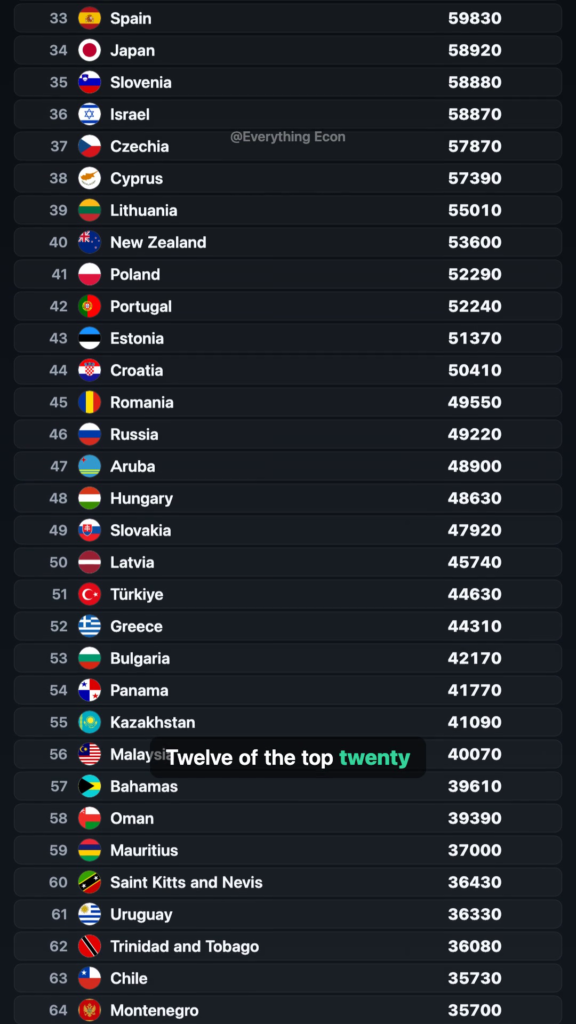
When economists compare how rich nations are, they often use a measure called income per person, sometimes shown as GNI per capita. This takes a country's total income and divides it evenly across everyone who lives there. It's not a measure of fairness — it says nothing about how that income is actually shared out — but it is a useful snapshot of how much economic output there is for each person, adjusted so that prices in different countries can be fairly compared. Looking at the full ranking, from the glittering wealth at the top to the hardship at the bottom, tells a story about what actually makes nations rich: trade, finance, oil, or sometimes just clever accounting.
Small places, big numbers
The countries with eye-watering income figures are rarely the ones you'd expect from population size or land area. Qatar sits at number two with $126,290 per person, built almost entirely on exporting natural gas to the rest of the world — a huge income stream shared among a very small population. Macao, in third place at $125,630, has taken a completely different route, turning itself into a casino and tourism hub that draws gamblers from across Asia. Then there's Ireland, in sixth place at $106,310. Ireland's figure is particularly misleading: a huge share of the income counted as Irish actually belongs to multinational companies that book their profits there for tax reasons. In 2022, this kind of activity made up 61% of Ireland's entire economic output, meaning ordinary Irish households don't see anything close to $106,310 in real living standards.
Why the giants don't always win
It's striking that the United States, despite having the world's largest economy, ranks only ninth at $89,490 — behind Singapore, Qatar, Macao, Norway, Luxembourg, Ireland, Switzerland and Brunei. Size matters less here than concentration: a country with a modest economy but very few people to share it among can easily out-rank an economic superpower with hundreds of millions of citizens. The same logic explains the strong showing of the United Arab Emirates, in 14th place at $81,640. Unlike some of its oil-rich neighbours, the UAE deliberately spread its wealth beyond oil, building up finance, trade and tourism industries centred on Dubai, which has helped it stay near the top of the table even as oil's importance to its economy has faded.
The bottom of the table
At the other end of the ranking, five countries — Liberia, Somalia, Mozambique, the Central African Republic and Burundi — all report incomes under $1,850 per person, with Burundi lowest at just $1,250. These are mostly countries that have faced long periods of conflict, weak infrastructure, or economies still heavily dependent on subsistence farming rather than industry or trade. The gap between Burundi's $1,250 and the leader's figure is enormous — more than one hundred times over — and illustrates just how unevenly global income is distributed.
The country on top
That leader is Singapore, at $135,750 per person. What makes Singapore's position especially notable is that, unlike many others near the top of this list, it has no oil wealth or tax haven status to lean on. Its wealth comes from being one of the world's busiest shipping and trading ports, combined with a highly developed finance industry. It shows that a small country with no natural resources can still out-earn, per person, every oil state and every financial centre on the planet.
Source: World Bank.
Get a new data story like this every week — join the newsletter.
Browse every visualisation on the visualisations page.