Every government borrows money — to build roads, pay doctors, fund armies, or simply keep the lights on. But how much is too much? One widely used measure is the debt-to-GDP ratio: the size of a government's total debt compared to the size of its economy. Think of it like comparing someone's mortgage to their annual salary. The higher the number, the heavier the burden. The IMF's latest World Economic Outlook ranks 178 countries on this measure, and the results are full of surprises.
At a glance · Top 5
Government gross debt, % of GDP, 2026
- 1Japan204.4%
- 2Singapore171.9%
- 3Sudan169.1%
- 4Bahrain152.4%
- 5Italy138.4%
Source: IMF World Economic Outlook
Not All High Debt Looks the Same
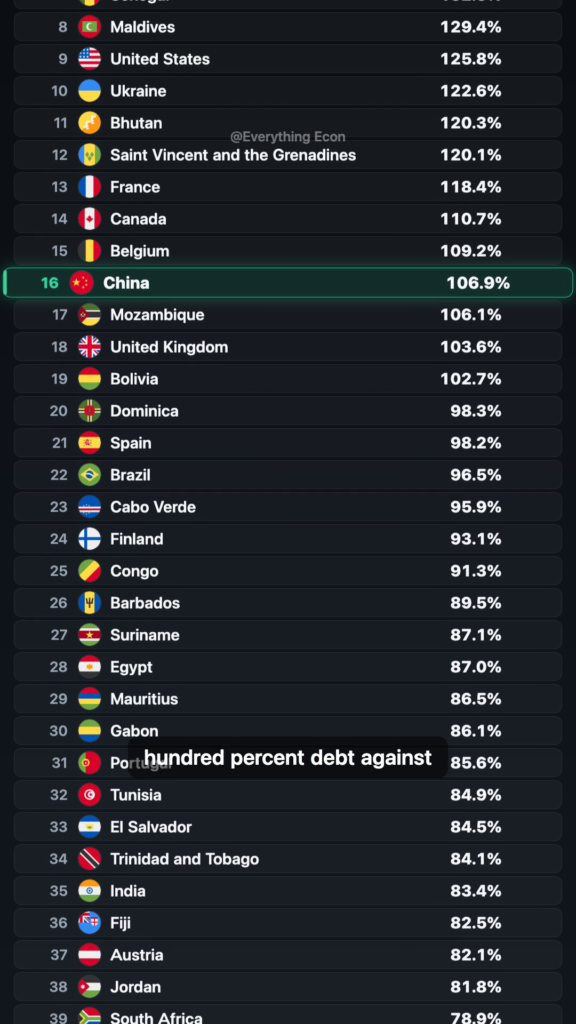
At first glance, seeing Singapore at number two — with a debt-to-GDP ratio of 171.9%, higher than Greece, Italy, or the United States — seems alarming. It isn't. Almost all of Singapore's debt is owed to its own national pension fund, meaning the government essentially borrows from its citizens' savings rather than from foreign creditors. Meanwhile, its sovereign wealth funds, GIC and Temasek, hold far more in assets than the debt itself. Markets understand this: Singapore holds a triple-A credit rating, the highest possible, despite the headline figure.
Greece tells a different story. Its ratio of 136.9% is still uncomfortably high, but it represents genuine progress — down from a peak of 207% in 2020. A recovery driven by tourism, real estate, and shipping has helped turn things around. Italy, at 138.4%, is also moving in the right direction: it cut its annual deficit from 7.2% of GDP in 2023 to 3.4% in 2024, helped by strong tax revenues.
France, sitting at 118.4%, is heading the wrong way. Attempts to slow the rise — including a deeply unpopular push to raise the retirement age — have met fierce public resistance, and the debt continues to climb.
War, Oil, and Tiny Islands
Sudan's appearance in third place, at 169.1%, is a reminder that debt crises and political crises often arrive together. Its ratio surged to that level in 2023, the same year a devastating civil war broke out, collapsing economic output while spending needs soared. Bahrain's story is different but equally instructive: its debt-to-GDP ratio roughly tripled between 2012 and 2023 after a crash in oil prices between 2014 and 2016 gutted the government's main source of income. When a country depends heavily on a single commodity, a price drop can rapidly unravel public finances.
At the other end of the ranking sit some of the world's wealthiest and most unusual economies. Brunei carries just 1.5% debt-to-GDP, sustained by oil and gas revenues. Liechtenstein sits at 0.5%. Macao, a territory whose economy is built almost entirely on casino revenues, records 0.0% — it has, in effect, no government debt at all.
The Country at the Top
Japan holds the number-one spot, with a debt-to-GDP ratio of 204.4% — the highest of any country on Earth. Decades of sluggish growth and persistent government deficits have piled up the borrowing, but the deeper driver is demographic. Japan's population is ageing faster than almost anywhere else: the share of people aged 65 or over rose from 18.4% in 2001 to 30.2% in 2024. More retirees means more spending on pensions and healthcare, and less working-age population generating tax revenue. Japan has managed this burden partly because most of its debt is held domestically, but the trajectory remains a serious concern for economists.
The United States, ranked ninth at 125.8%, is not in crisis — but the IMF projects its debt will climb from around 126% in 2026 to 142% by 2031, the steepest rise among wealthy nations. The direction of travel matters as much as the current number.
Data: IMF World Economic Outlook.
Get a new data story like this every week — join the newsletter.
Browse every visualisation on the visualisations page.