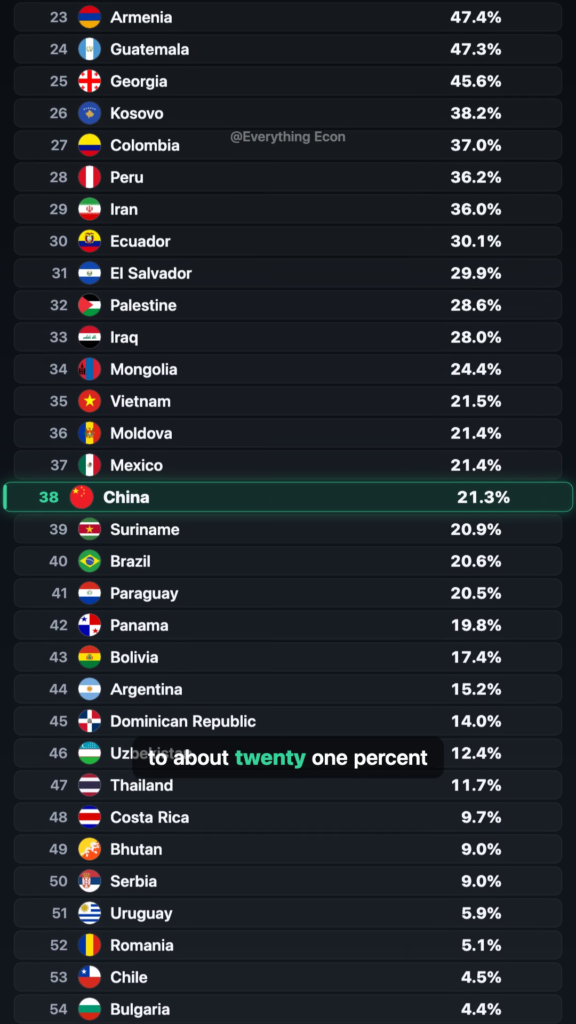
The $6.85-a-day line is the World Bank's benchmark for poverty in upper-middle-income countries — not destitution exactly, but a level of income too thin to reliably cover food, housing, healthcare and a bit of margin for shocks. Measured this way, global poverty looks far more widespread than headlines about "extreme poverty" (usually pegged at $2.15 a day) suggest. Around 695 million people live below that lower line, but hundreds of millions more sit just above it, still short of the $6.85 mark. This ranking lists the share of each country's population falling under that threshold, from the highest percentages down to the lowest.
Africa's near-universal poverty
Seven of the top eight places on this list are in Sub-Saharan Africa, and the numbers are stark: Zambia (94.0%), Uganda (93.6%), Nigeria (92.9%), Kenya (90.1%), Rwanda (89.8%) and Chad (89.5%) all have at least nine in ten people living under $6.85 a day. Nigeria's figure is especially significant because of the country's sheer size — with over 220 million people, it alone accounts for roughly 15% of everyone in the world living in extreme poverty. Chad's near-universal rate reflects weak infrastructure and an economy still dominated by subsistence farming, where cash income is scarce even when people are feeding themselves.
The regional pattern is consistent: Sub-Saharan Africa holds 80% of the world's extremely poor people while making up just 14% of the world's population, and the region's average poverty rate (83.2%) is about 23 times higher than Europe's (3.6%).
Syria, Pakistan and India: three different stories
Not every country near the top got there through long-term underdevelopment. Syria ranks 8th-worst at 89.3%, but it was a middle-income country before its 2011 civil war tore apart its economy and infrastructure — a reminder that poverty rankings can capture the damage of conflict as much as structural poverty. Pakistan, at 87.1%, has been pushed higher recently by currency devaluation, inflation and the lasting damage of major floods. India presents a different puzzle: despite years of strong GDP growth and a large, globally visible tech and services sector, 80.0% of its population still lives under $6.85 a day, showing how unevenly growth can be shared across a population of 1.4 billion.
China offers the clearest counterexample of change in the other direction. Its rate has fallen from 24.7% in 2020 to a projected 11.1% in 2025, among the fastest poverty reductions on record.
The top of the list — and the bottom
At the very top of the ranking is Mozambique, where 96.3% of the population lives under $6.85 a day — the highest rate anywhere in the world. It is a sobering figure: in a country of roughly 33 million people, barely one in 25 people clears a bar that, in wealthier countries, would still count as a low income. Mozambique's position reflects a combination of limited industrial development, dependence on agriculture, and exposure to natural disasters like cyclones that regularly set back economic progress.
At the opposite end of the table, the pattern flips entirely. Slovenia and Cyprus tie for the world's lowest rate, at just 0.1%, just ahead of Luxembourg at 0.2%, with France and Ireland close behind at 0.3%. These are wealthy European economies with mature welfare systems, stable institutions and diversified, high-income economies — conditions that are essentially the mirror image of what drives the countries at the top of this list.
Source: World Bank.
Get a new data story like this every week — join the newsletter.
Browse every visualisation on the visualisations page.