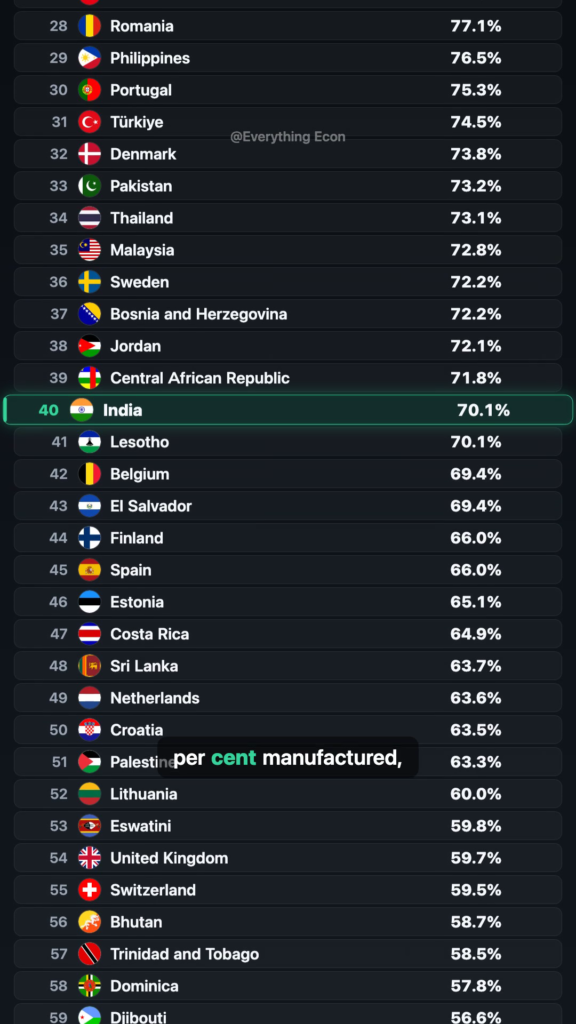
Every country sells something to the rest of the world — oil, wheat, tourism, financial services, or things built on an assembly line. This ranking looks specifically at that last category: what share of a country's total exports are manufactured goods, things like machinery, electronics, vehicles, chemicals, and processed materials, rather than raw commodities, crops, or services. A high score doesn't necessarily mean a country exports the most factories' worth of stuff in absolute terms — it means that almost everything it sells abroad has been through some kind of industrial process. The World Bank's figures reveal some predictable industrial giants near the top, but also a few results that only make sense once you understand what counts as "manufactured."
Europe's hidden factory belt
A cluster of Central European countries dominates the upper reaches of this list: Czechia at 90.0%, Slovakia at 88.9%, and Slovenia tied with it at 88.9%, with Hungary close behind at 82.0%. None of these are famous as industrial superpowers, but all of them have spent decades plugged into Germany's manufacturing supply chains, building cars, car parts, machinery, and electronics that get assembled, shipped, and re-exported across the European Union. Germany itself shows up at 83.3%, the anchor of that whole network. These economies sell relatively little in the way of raw materials or farm goods, so when they do export, it's almost always something that came off a production line.
Giants, diamonds, and a pharmaceutical boom
China sits at 90.5%, which is remarkable given its sheer size — it isn't just that manufactured goods dominate its export mix, it's that China is now the single largest exporter in close to 60% of all product categories traded worldwide, a dominance built up from almost nothing in the early 2000s. Ireland, at 91.4%, tells a different story: its export mix is overwhelmingly pharmaceuticals, with exports in that sector alone rising from €22bn a decade ago to €139bn in 2025, making Ireland the world's third-largest pharmaceutical exporter and home to nine of the top ten global drug companies. Then there's Botswana at 86.3%, which looks like an industrial economy on paper but isn't one in the way people usually mean it — cut and polished diamonds count as "manufactured goods" under the World Bank's definition, which is what lifts a diamond-cutting economy this high. Vietnam, at 85.0%, is the clearest case of a country climbing this list in real time, as manufacturing shifts away from China land there instead; its industrial output grew 9.5% in 2025, the fastest pace since the pandemic, with the broader economy expanding close to 8%.
At the other end, countries like Maldives (0.2%), Guyana (0.2%), Seychelles (0.3%), Iraq (0.4%), and Mauritania (0.5%) sit near zero. These are economies built on tourism, oil, fish, or minerals sold largely in raw form — there's simply very little factory activity in the export mix at all.
The surprise at the very top
The number one spot belongs to Andorra, at 91.5%. This isn't an industrial powerhouse — it's a tiny mountain microstate between France and Spain, known for skiing and tax-free shopping, not factories. The result comes down to how small and narrow Andorra's total export basket is: with so little in the way of raw materials or farm produce to sell, the modest trickle of goods it does export abroad happens to be overwhelmingly manufactured items, which is enough to push its share above even China's.
Source: World Bank, latest available year.
Get a new data story like this every week — join the newsletter.
Browse every visualisation on the visualisations page.