
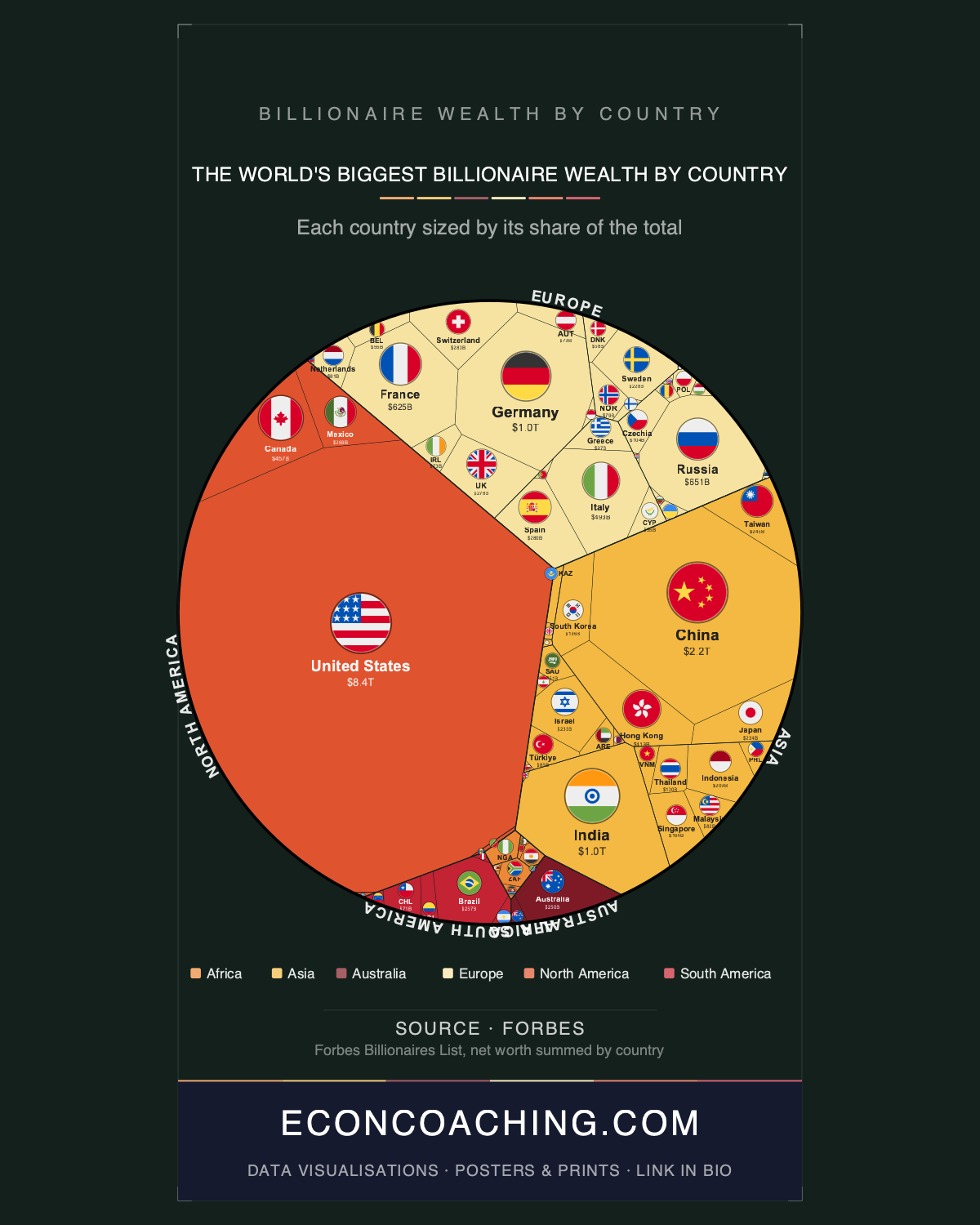
The United States' billionaires are worth $8.42 trillion combined, more than the billionaire fortunes of China, India, Germany, Russia, France, Italy, Canada, Hong Kong and Spain put together at $7.13 trillion. That comparison is visible in the treemap accompanying this article, where each country's cell is sized by billionaire wealth rather than land area or population. The US cell dominates the chart not because it holds more billionaires than anywhere else, but because of how much each one is worth.
The US's 42% Share, and How It Got There
The United States accounts for 41.98% of all billionaire wealth in this dataset, a $20.047 trillion total across 3,428 billionaires in 75 countries that closely matches Forbes' own 2026 World's Billionaires figure of $20.1 trillion. When Forbes launched that list in 1987, it counted around 140 billionaires worldwide. The 2026 figure is roughly 24 times larger. Much of the acceleration in US and global billionaire wealth dates to the years after the 2008 financial crisis, when ultra-low interest rates and quantitative easing pushed up the public equity prices on which most billionaire fortunes are marked to market.
China's Paradox: More Billionaires, Less Combined Wealth
China's billionaires are worth $2.18 trillion combined, second on the list but less than a quarter of the US total. Headcount data tells a different story: the Hurun Global Rich List 2026 recorded 1,110 Chinese billionaires against roughly 1,000 in the United States, meaning China reclaimed the title of the world's billionaire capital by number for the first time in three years. Total wealth still favours the US by close to a factor of four. China's billionaire class is largely a post-2000s phenomenon, built on market reforms and a stock market boom with no US equivalent, and the gap between its lead in headcount and its lag in total wealth shows how differently these two rankings can be read.
India Crosses the Trillion-Dollar Mark
India's billionaires crossed a combined $1.02 trillion in 2026 for the first time, tying Germany for third place on the list. The milestone came with a record 229 Indian billionaires, up from 205 the year before, an addition of 24 individuals in a single year. India's total now sits directly behind China's $2.18 trillion, and its rate of new billionaire creation makes the tie with Germany one of the more direct positions to watch in future editions of this ranking.
When One Family Sets a Country's Ranking
National billionaire-wealth totals in this dataset are frequently set by one or two individuals rather than broad-based wealth creation. Carlos Slim and family are worth roughly $125 billion, about 46% of Mexico's entire $269 billion billionaire total. Bernard Arnault of LVMH, worth around $171 billion in 2026, alone exceeds the combined billionaire wealth of every African country in this dataset: roughly $140 billion spread across Nigeria, South Africa, Egypt, Morocco, Algeria, Tanzania, Eswatini and Zimbabwe. Arnault's fortune also shows how volatile these figures are. It peaked at $233 billion in 2024 before falling to $171 billion in 2026 as LVMH's share price declined, a swing large enough on its own to move France's position in the global ranking.
The Hubs and Regions the Treemap Distorts
Hong Kong's billionaires are worth $419 billion combined, more than every billionaire in Brazil, Chile, Colombia, Argentina and Venezuela put together at $409 billion, despite Hong Kong being a single city rather than a continent. Because these totals reflect where billionaires are counted as citizens or headquartered, rather than where their wealth is invested or economically active, a Hong Kong-domiciled fortune may have limited direct connection to Hong Kong's own economy. Russia's billionaires, at $651 billion, are worth more than the UK ($278 billion) and Switzerland ($280 billion) combined, showing that Western sanctions imposed since the 2022 invasion of Ukraine have not dislodged Russia from the world's top five. At the other extreme, Africa's eight billionaire-holding countries, home to roughly one in six people worldwide, account for just 0.7% of global billionaire wealth: $140 billion of $20.05 trillion. Africa counted only 22 billionaires in 2025, with South Africa (7), Nigeria (4) and Egypt (4) making up 15 of them, and combined African billionaire wealth of about $105 billion that year has since risen further into 2026. Elon Musk's own fortune, which passed half a trillion dollars in October 2025, the first individual net worth in history to do so, is roughly equal on its own to Canada's and Hong Kong's national billionaire-wealth totals combined.
Global billionaire wealth reached a record $20.1 trillion in 2026 across 3,428 billionaires, 400 more people than in 2025, close to one new billionaire every day of the year. That followed a 16% jump in 2025 alone, to $18.3 trillion, three times the average annual pace of the previous five years, and total billionaire wealth has grown 81% since 2020 according to Oxfam International. With China closing the headcount gap on the US, India tied with Germany at the trillion-dollar mark, and individual fortunes such as Arnault's and Musk's able to swing a country's ranking within a year or two, the next edition of this dataset is likely to reorder the middle of the table well before it changes the country at the top.
One chart like this in your inbox each week, explained in plain English — join the Everything Econ newsletter. Always free, and you can unsubscribe any time.
Take this one home
Get this visualisation as a download, wallpaper, or printed poster.
← Back to all visualisations & articles
Follow Everything Econ: YouTube · TikTok · X · Instagram · Facebook